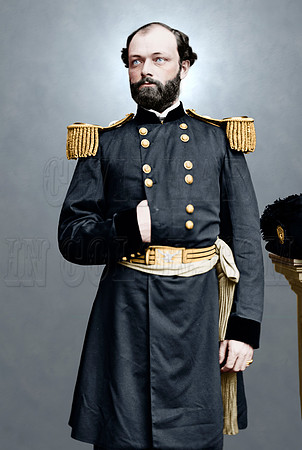
Gen. Quincy Gillmore - 06490
“The reduction of that work [Ft. Pulaksi] practicable, by batteries of mortars and rifled guns established on Tybee Island.” - Capt. Quincy Gillmore
Fort Pulaski was built to protected Savannah, Georgia from foreign invaders after the War of 1812. With its thick brick walls, Pulaski was considered an impregnable modern fort by both the North and South.
In August of 1861, the Union became determined to take back Pulaski. Both sides believed Pulaski would be starved out before taken by force.
U.S. Capt. Quincy Gillmore thought otherwise. He convinced his superiors that experimental rifled guns could blast Pulaski's walls down.
On April 10, 1862, a messenger bearing a white flag with a formal document demanding the surrender of Pulaksi, "to avoid the effusion of blood". The demand was declined.
According to C.S. Col. Charles Olmstead, Cmdr Fort Pulaski, "In the very first hour of the firing I saw the bricks under one of the embrasures bulged inward by a shot that struck the outer wall while it was yet intact; a very disquieting fact to one who understood its significance. … By afternoon, the Union bombardment broke through the heavy walls."
The white flag was raised over Pulaski on April 11. Gillmore’s use of rifled cannons, had rendered masonry fortifications obsolete around the world.