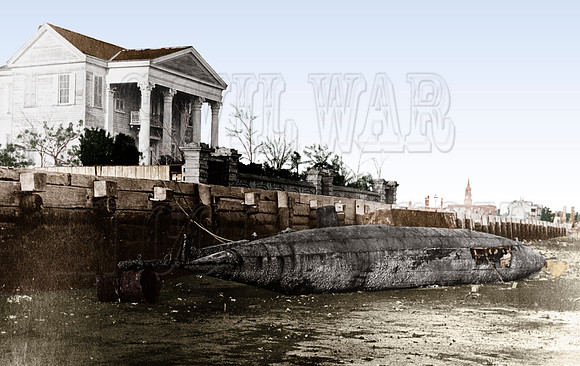
David torpedo boat in front of John A. Alston’s mansion, on Chisolm’s Causeway, March 23, 1865 - 165-C-752
"It is now nine o'clock. Shall we strike her?" – C.S. Lt. William T. Glassell
On September 7, 1863, the Federals captured Morris Island, Charleston, S.C., after hard-fought battles. Instead of competing with the North’s ability to build large vessels, C.S. Capt. Francis D. Lee obtained approval to build the first assault boat in world naval history.
Intrigued with the concept of attaching underwater explosives to enemy ships, Lee tinkered with fuses and torpedoes.
He designed a cooper torpedo containing one hundred pounds of gun powder.
It had not one but four separate primers. Each chemical fuse was placed into a glass vial, protected by a three-inch lead tube, capped by a thin piece of metal. Dent the cap, ignite the torpedo.
A stealth vessel was needed to come along side of the enemy ship to position the torpedo. A 50-foot-long, six-foot-wide cigar shaped boat was built.
Its tallest feature was an armored iron funnel. The steam engine powered the one propeller to reach 7 knots. A fourteen-foot-long, hollow iron spar to place the torpedo was attached to the bow.
Ballast tanks similar to a submarine’s, enabled her to sink, leaving only part of her deck above the water when stalking prey. Perhaps inspired by the story of David and Goliath, she was named CSS David.
On October 5, 1863, the David tried but failed to sink the USS New Ironsides.