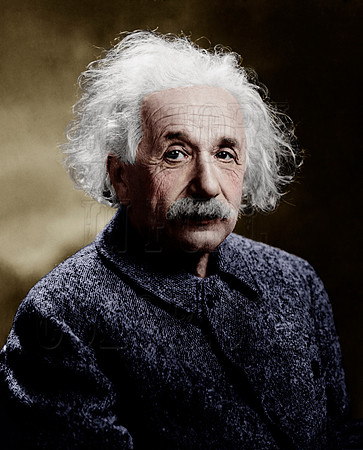
Albert Einstein - 1947 - 3b46036
“The important thing is not to stop questioning. Curiosity has its own reason for existing.” - Albert Einstein
For Albert Einstein, 1905 was his “Annus Mirabilis” (miracle year). He published four science changing papers. His third paper, describing light comes in packets called protons, won him the Nobel Prize. His fifth paper, introduced the iconic equation E=mc2 to the world. However, a theory is just a theory until it is proven with a practical application.
At the start of the First World War, Einstein was at the Prussian Academy of Sciences in Berlin, Germany. In England, Arthur Stanley Eddington had been appointed Chief Astronomer at Cambridge and was the Secretary of the Royal Astronomical Society. While reviewing Einstein’s work, Eddington realized that the answer to why the planet Mercury didn’t follow Newton’s Laws of Gravity may be answered.
Although scientific communication was officially severed due to the War, both scientists believed that the truth in science rose above all and continued to work on the problem. Despite the ill will from the Germans using chlorine gas during the War, Eddington had the clout to fund an expedition to photograph the May 29, 1919, solar eclipse from the African island of Principe.
After his expedition, Eddington not only was able to prove Einstein’s Theory of Relativity, he was able to explain it in layman’s terms. Einstein instantly became famous and won the Nobel Prize in 1921.