Lawrence of Arabia
Note: This image was hand colored in the 1920's
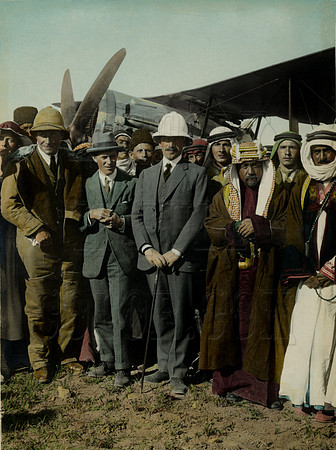
On the Aerodrome at Amman. Col. T.E. Lawrence. Sir Herbert Samuel. Amir Abdullah. April, 1921
Photograph also shows a woman, possibly Gertrude Bell, at left and Sheik Majid Pasha el Adwan at far right.
Thomas Edward Lawrence, CB, DSO (16 August 1888 – 19 May 1935), known professionally as T. E. Lawrence, was a British Army officer renowned especially for his liaison role during the Sinai and Palestine Campaign and the Arab Revolt against Ottoman Turkish rule of 1916–18. The breadth and variety of his activities and associations, and his ability to describe them vividly in writing, earned him international fame as Lawrence of Arabia, a title which was used for the 1962 film based on his World War I activities.
Lawrence was born illegitimate in Tremadog, Wales, in August 1888 to Sir Thomas Chapman and Sarah Junner, a governess who was herself illegitimate. Chapman had left his wife and first family in Ireland to live with Sarah Junner, and they called themselves Mr and Mrs Lawrence. In the summer of 1896 the Lawrences moved to Oxford, where in 1907–10 young Lawrence studied history at Jesus College, graduating with First Class Honours. He became a practising archaeologist in the Middle East, working at various excavations with David George Hogarth and Leonard Woolley. In 1908 he joined the Oxford University Officer Training Corps, undergoing a two-year training course. In January 1914, before the outbreak of World War I, Lawrence was co-opted by the British Army to undertake a military survey of the Negev Desert while doing archaeological research.
Lawrence's public image resulted in part from the sensationalised reportage of the revolt by an American journalist, Lowell Thomas, as well as from Lawrence's autobiographical account, Seven Pillars of Wisdom (1922). In 1935, he was fatally injured in a motorbike crash in Dorset.