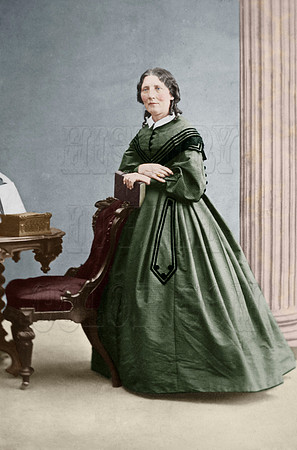
I10041 - Harriet Beecher Stowe
"...if I could use a pen as you can, Hatty, I would write something that would make this whole nation feel what an accursed thing slavery is." Isabella Porter Beecher, sister-in-law of Harriet Beecher Stowe
Harriet Beecher Stowe was the author of "Uncle Tom's Cabin". By using her pen, she was able to do what other abolitionists had not - personalize the sufferings of slaves. What started off as a newspaper serial to "paint a word picture of slavery" turned the tide in the way Americans viewed slavery.
Before writing "Uncle Tom's Cabin", Stowe's encounters with slavery ranged from hearing first hand stories from former slaves, employing fugitives, hiding runaways in her home in Maine and seeing a slave auction in Maysville, KY.
But it was the death of her 18 month old son of cholera in 1849 that gave her the ability to truly empathize with slaves that allowed her to write the book. Stowe said, "Having experienced losing someone so close to me, I can sympathize with all the poor, powerless slaves at the unjust auctions. You will always be in my heart Samuel Charles Stowe."
"I estimate the value of anti-slavery writing by the abuse it brings," abolitionist William Lloyd Garrison wrote to Stowe after reading her book. "Now all the defenders of slavery have let me alone and are abusing you."
For different reasons, "Uncle Tom's Cabin" was an instant sensation both in the North and South. At 40, Stowe became an internationally famous, wealthy and controversial woman. Given the choice to be paid by a flat fee or royalty, she chose a royalty. Within the first week the book sold over 10,000 copies. In England it sold over a million copies in a year.
Stowe's celebrity opened many doors, including the opportunity to have tea with President Lincoln at the White House. She was invited to use her influence for social reform. Queen Victoria, who wanted to meet her, settled for arranging to pass the controversial Stowe's carriage on the road, so the two women could silently nod to each other.
On January 1,1863, on the day that the Emancipation Proclamation was signed, Stowe received a spontaneous recognition from her abolitionist peers. It happened during a celebratory "grand jubilee concert" at Boston's Music Hall, MA. Towards the end of the program, an announcement was made that the long awaited Proclamation had been signed by Lincoln. The crowd began to chant "Harriet Beecher Stowe, Harriet Beecher Stowe." Stowe rose from her seat in the balcony and bowed shyly.