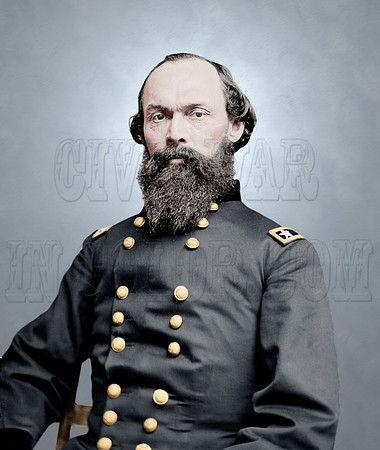
06932 - US Gen Gordan Granger
“The battle is neither to the swift nor to the strong but to him that holds on to the end.” - US Gen. Gordon Granger
West Point graduate US Gen. Gordon Granger is best known for coming to US Gen George “Rock of Chickamauga” Thomas’s aid during the Battle of Chickamauga, GA; providing land support during the Battle of Mobile Bay, AL; and after the War ended, as the commander of the newly formed District of Texas, issuing General Order No. 3, freeing the slaves of Texas on June 19, 1865, resulting in the holiday known as Juneteenth.
By the time the Civil War began, Granger had 30 years continuous service in the Army. He was a stickler for following military procedure but earned the ire of US Gen Grant by refusing to move without adequate supplies for his men. Granger was described by a longtime friend as “gruff on the exterior . . . for the mere tinsel of rank he had no respect…. At the core his heart was tender and gentle; and his tender sympathy ever went out toward misfortune, sorrow and suffering.”
On the second day of the Battle of Chickamauga, Granger realized from the noise, dust and smoke, the Battle was south of where he was located. Climbing on top of a haystack, he watched and listened. Some of his officers felt thought the Confederates were retreating. Granger disagreed and “… jumped to his feet, thrust his glass into its case, and exclaimed with an oath: ‘I am going over to Thomas, orders or no orders.’” It was pointed out that he could be court-martialed. Granger responded: “There’s nothing in our front now but ragtag, bobtail cavalry. Don’t you see Bragg is piling his whole army on Thomas! I am going to his assistance.”
To reach Thomas, the men had to march for a mile under heavy fire, pass mangled bodies, and “…the entire country seemed to be one smoking, burning sea of ruin.” On arrival, the men were immediately tasked with charging the Confederates coming over a rise and sweeping them back down the ridge.
Thomas would later say that “Fifteen minutes more … might have been to late…. This opportune arrival of fresh troops revived the flagging spirits of our men on the right, and inspired them with new ardor for the contest. Every assault of the enemy from that time until nightfall was repulsed in the most gallant style by the whole line.”
If Granger had been assigned to the Eastern front, he may be better known today.