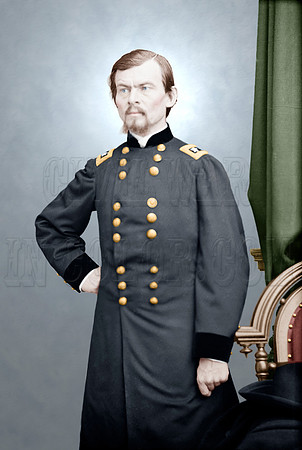
05089 - Maj. Gen. Franz Sigel
“I fights mit Sigel” – German American Soldiers
Franz Sigel, an idealist and “champion for democracy” rallied the immigrant community to the Union cause. “I fights mit Sigel” became a hallmark of German American participation in the War.
Siegel was born in Germany, graduated from the military academy and made a name for himself fighting in the failed Revolution of 1848. Emigrating to New York City, he taught school. Moving to St. Louis, he became a leader in the large German community. Between his avid supporters and raising troops in St. Louis, Siegel was promoted to Brig. General.
It was the start of the idolatry of Sigel that would last decades after the War. Popular ballads and poetry touting loyalty to Sigel were circulated. Sigel received hundreds of letters of support. In December of 1861, Sigel went on medical leave. On the 25th, U.S. Gen. Samuel Curtis was appointed commander of the Army of the Southwest. Sigel, feeling slighted, resigned his commission to return to teaching. The leaders of the military, who considered Sigel "superior in theoretical [tactics), incompetent in battle and hell on retreat", accepted his decision.
However, the German community sprang into action. Committees were formed in New York and Chicago, a Congressional investigation was demanded, German soldiers threatened to resign. Sigel was presented a sword engraved with the inscription, “Defender of Liberty” and a silver goblet. In the end, Sigel returned to the army under Curtis’s command.
The 1862 Battle of Pea Ridge, Ark., was the high point of Sigel’s military career. Using his artillery, Sigel turned a possible Union defeat into an overwhelming victory. The battle gave the Union control of Missouri for the next two years. Sigel was promoted to Maj. General. Although he would eventually lose his command, Sigel’s supporters never wavered.
At his death in New York City in 1902, 25,000 people attended his visitation. In 1909, 100,000 people in New York City honored his memory with a parade. Statues have been dedicated, schools, parks and a WWII Liberty ship have been named after the man who inspired German-Americans to fight for the ideals of freedom and democracy.