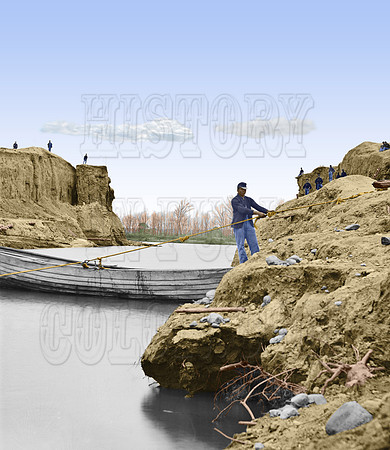
02192 - View of Completed Canal, Dutch Gap Canal, Virginia, April 1865 (LC-DIG-cwpb-02192)
While Dutch Gap Canal, shown here, is one of the best known examples of canal work during the Civil War, it was not alone. Many existing canals were put to use by both sides to help deliver troops, in an era when unpaved roads and un-cleared wilderness presented formidable obstacles.
During the Vicksburg campaign, General Grant even attempted to divert the entire Mississippi River by the use of a Canal. In June of 1862, the army set about to build a canal that would change the course of the river. There by effectively moving Vicksburg away from the river and allowing the Union to control the entire river by avoiding the Confederate guns in the city.
The canal grew to 18 feet wide with a depth of 13 feet. Due to the heat of the summer, the men became exhausted and soon succumbed to disease. Former slaves were brought in to continue the work. In January of 1863, the river rose and breached the dam, separating it from the main river channel. Steam dredges were brought in, but to no avail. The canal was abandoned and Grant would finally take Vicksburg, seven months later, on the 4th of July. Only a small portion of the original canal exists today as part of the Vicksburg National Military Park.